
AI Vision Camera Setup & Finished Fabric Roll
Inspection Software
A deep learning model is only as good as the optical signal it receives. eManage combines calibrated line-scan cameras, engineered raking and diffuse lighting geometry, and sub-millimeter deep learning defect classifiers to stop defect leakage before fabric ever reaches the cutting table.
eManage AI Vision Fabric Inspection provides inline automated defect detection and 4-point roll grading for textile mills. Using calibrated line-scan cameras (up to 16K pixels) and multi-angle lighting, it detects holes down to 1mm, slubs, stains, reed marks, dropped stitches, and shade variations at speeds up to 30 m/min, linking digital defect maps directly into eManage ERP.
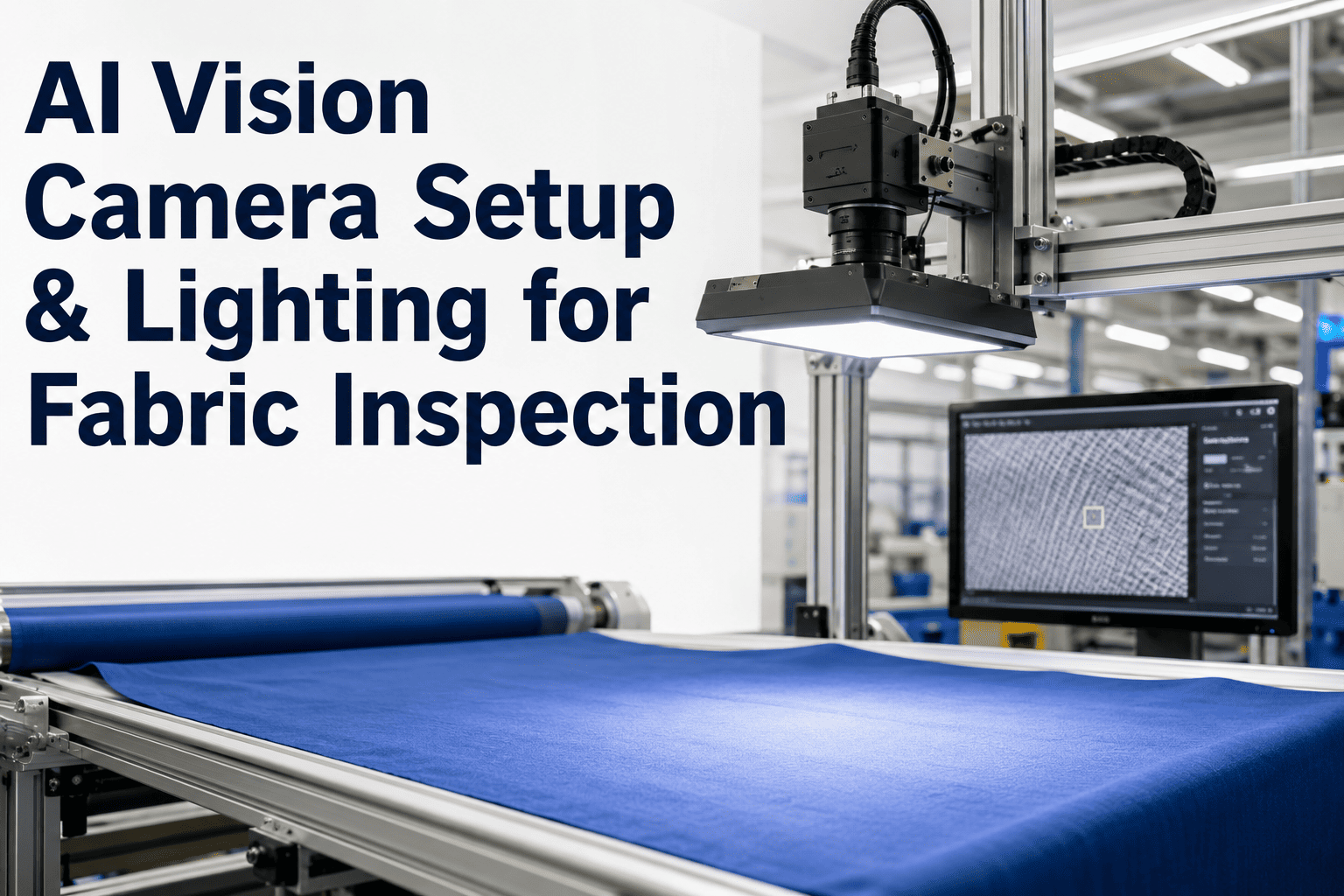
Why Human Eye Inspection Fails at 20 Meters Per Minute
Finished fabric rolls leaving stenter frames and finishing lines carry weeks of spinning, weaving, dyeing, and chemical finishing investment. Yet most mills still rely on fatigued human checkers under 4-point lamps.
Defect catch rate drops sharply after the first 90 minutes of a shift due to cognitive visual fatigue and blink-rate blindness.
Faster than the human eye can track fine warp streaks, sub-millimeter pinholes, or 2mm broken picks across a 2-meter wide web.
Production value downgraded, rejected, or disputed at garment factories and buyers due to missed defects shipped from the mill.
Continuous line-scan coverage with zero fatigue, standardized 4-point penalty logging, and automatic defect mapping into ERP.
| Operational Capability | Manual 4-Point Inspection | eManage AI Vision Inspection |
|---|---|---|
| Detection Accuracy | 60% – 70% (degrades rapidly after 90m) | 93% – 96% sustained 24/7 across all shifts |
| Inspection Web Speed | Limited to 10 – 15 m/min for human eye tracking | Full production speed up to 30+ m/min |
| Defect Coordinates & Meter Tagging | Handwritten paper logs with approximate meter estimates | Sub-millimeter encoder coordinates (X/Y) linked to Roll ID |
| Shade Variation & Color Banding | Subjective visual estimate under variable ambient lamps | Calibrated spectrophotometric ΔE measurement |
| Buyer Dispute Defense | None; word of auditor vs word of buyer | Exportable PDF defect map + high-res image audit log |
Line-Scan Camera Geometry & Acquisition Math
Before a deep learning model can classify a single broken pick or oil stain, the optical hardware must capture sufficient pixel density without motion blur. The Nyquist sampling criterion requires at least 4 to 8 pixels across the smallest defect dimension for deep-learning classification.
tune Interactive Line-Scan Sizing Calculator
Engineered Lighting Geometry for Textile Surfaces
Fabric surfaces combine specular fiber reflections, diffuse yarn scattering, and physical surface relief. A single generic overhead light cannot detect both color drift and surface relief.
Low-Angle Raking Light (10°–30°)
Striking the fabric at a shallow angle casts pronounced 3D relief shadows from warp streaks, reed marks, slubs, snarls, and missing picks.
Diffuse Dome / Cloud Lighting
Omnidirectional, shadow-free illumination eliminates directional glare, accurately revealing shade banding, weft density bars, and chemical stains.
Transmitted Backlighting
High-intensity LED light bank positioned behind the moving web transmits through fabric, detecting microscopic pinholes, thin spots, and missing yarns.
Multi-Angle Polarization Strobing
Sequentially fired illumination lines synchronized with camera triggers separate specular fiber glint from true substrate defects in high-value fabrics.
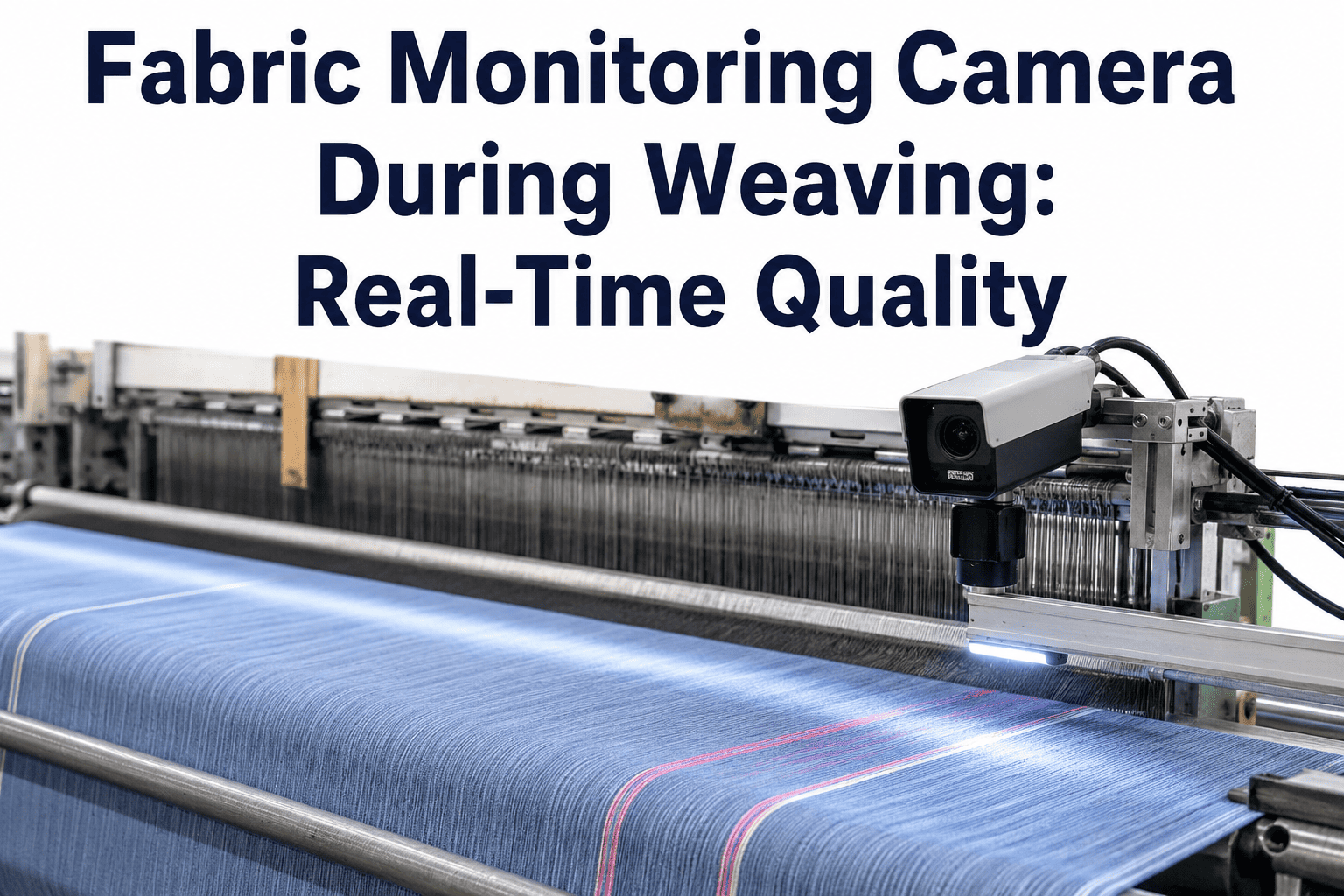
Inline Loom & Weaving Inspection
Monitors warp and weft insertion directly on airjet, rapier, and projectile looms before cloth rolling.
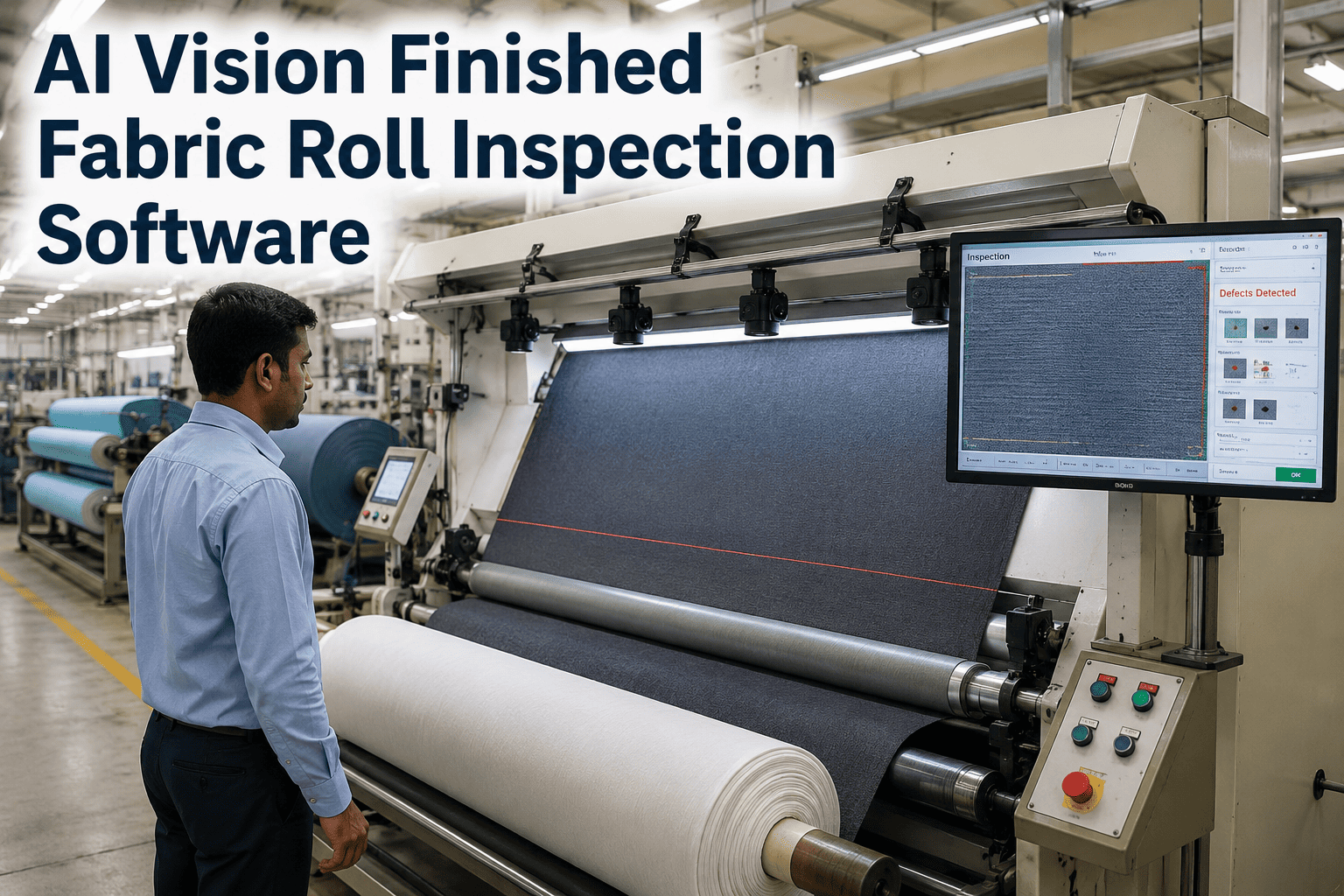
Finished Roll Stand & Batching Inspection
Continuous inspection on final rolling frames with automatic 4-point ASTM grading and barcode tag printing.
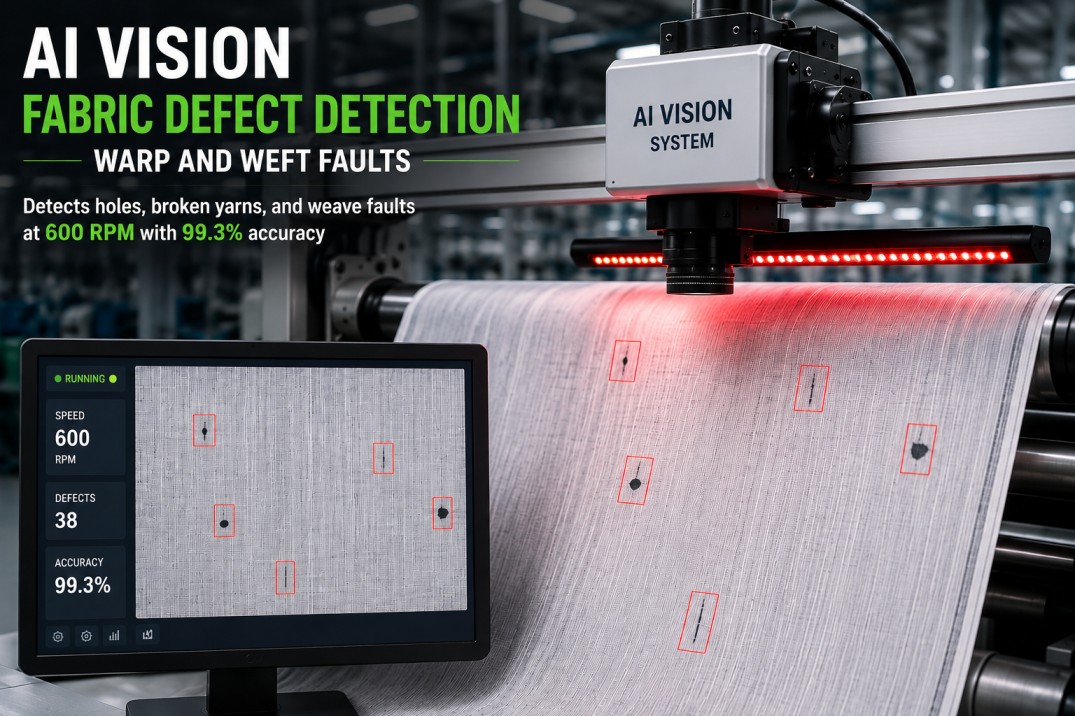
Warp & Weft Defect Classification
Classifies snags, broken picks, oil stains, and hole clusters with real-time bounding box visualization.
Automated Stop Cause Diagnostics & Knitting Cylinder Telemetry
When a circular knitting machine stops, production managers need to know precisely why. eManage links optical sensors inside the knitting cylinder directly to the machine stop relay and eManage ERP.
Six Defect Families Recognized on Every Fabric Roll
Trained on millions of running meters across cotton, viscose, polyester, blends, and woolens. Every flaw is tagged with exact meter coordinates, severity points, and routing decisions.
Stains & Machine Oil Marks
Detects lubricant leaks, water droplets, chemical spots, and rust marks using color deviation contrast models even on patterned fabrics.
Pinholes, Tears & Slits
Backlight transmission algorithms detect punctured yarns, needle cuts, and snags down to 1mm, scoring them instantly on the ASTM penalty scale.
Shade Variation & Listing
Monitors edge-to-edge listing, side-to-side variation, and roll-to-roll batch shading against the master dye lot standard.
Weaving & Knitting Faults
Identifies slubs, missing ends, double picks, dropped stitches, reed lines, and bar marks against real-time structural pattern references.
Selvedge & Edge Damage
Tracks selvedge curling, uneven width, fraying, and stenter pin tears continuously along both outer borders of the running web.
Print & Rotary Screen Drift
Automatic optical alignment verifies screen registration, color bleeding, and repeat pitch accuracy against the digital design master.
ASTM D5430 Automated 4-Point Roll Scoring
Rather than subjective inspector estimates, the optical engine mathematically computes penalty points per 100 square yards with millimeter precision:
Penalty Points / 100 yds² = (Total Penalty Points × 3600) / [Length (yds) × Width (inches)]
| Defect Length | Penalty | Grade Threshold | ERP Routing |
|---|---|---|---|
| < 3.0 inches (75mm) | 1 Point | ≤ 4.0 Points | Grade A · Pass |
| 3.0 to 6.0 inches | 2 Points | 4.1 to 7.0 Points | Grade B · Commercial |
| 6.0 to 9.0 inches | 3 Points | > 7.0 Points | Mending Required |
| > 9.0 inches or Holes | 4 Points | > 15.0 Points | Reject · Scrap |
Automated ERP Routing: First Quality, Mending, or Downgrade
Once a roll is completed, its final 4-point penalty score determines whether the roll is marked ready for customer dispatch, automatically routed to the mending department with exact coordinate tags, or downgraded in the eManage inventory ledger.
AI Fabric Inspection & Vision Systems: Key Questions
How does AI vision line-scan technology compare to human inspectors on fabric inspection frames? expand_more
Can the system detect defects on both woven and knitted fabrics? expand_more
How does the automated roll grading and 4-point scoring work? expand_more
Does the system integrate with circular knitting machines to stop production on defects? expand_more
What camera interface and hardware specifications are recommended for wide fabric lines? expand_more
Fabric Optical Quality Assessment
Eliminate Defect Leakage on Your Inspection Frames
Stop paying downstream garment claims for weaver and knitting faults. Schedule a turnkey line-scan camera audit with our optical engineers.