
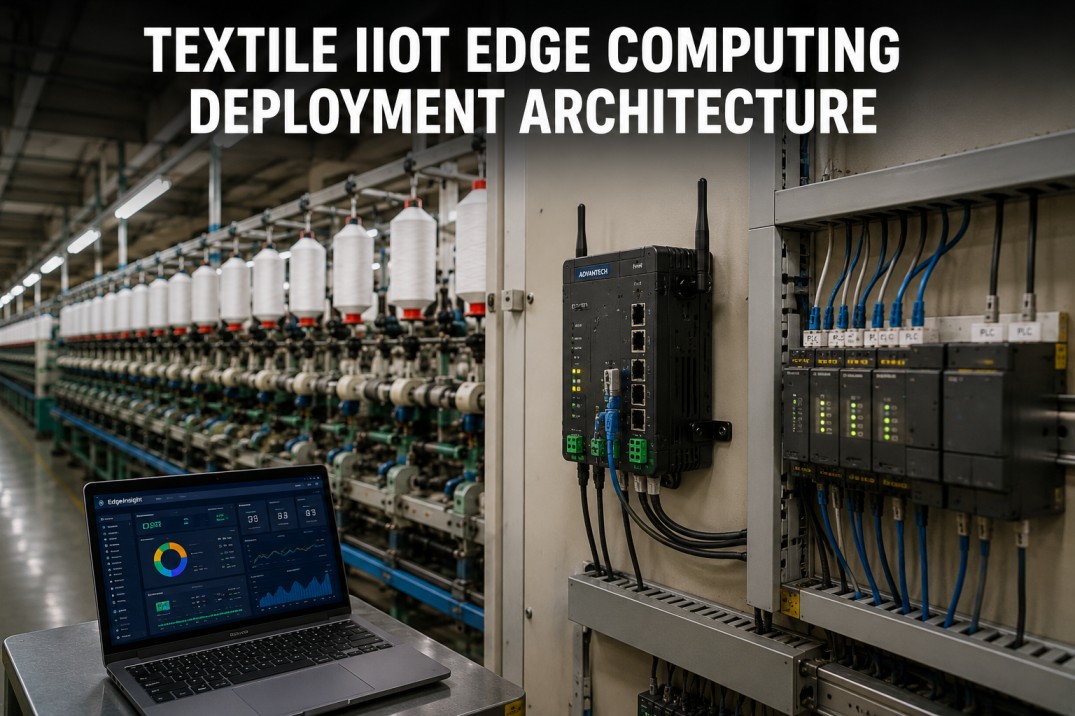
Textile IIoT Edge Computing
Deployment Architecture
Textile spinning, weaving, and finishing generate millions of sensor events per minute. Sending raw mill streams directly to the cloud causes latency lag and bandwidth blowouts. eManage delivers sub-50ms edge processing with 72-hour offline store-and-forward resilience.
Textile IIoT Edge Computing Architecture deploys on-premise compute nodes across textile mills to process sensor data locally within 10 to 50 milliseconds. Spanning four tiers—Sensor Level, Edge Gateway, Edge AI, and Cloud Platform—it normalizes OPC UA, MQTT, and Modbus protocols, buffers data for 72 hours during network outages, and cuts cloud bandwidth consumption by 90% to 98%.
Four-Tier Textile Edge Architecture: Sensor to Cloud
Progressive data reduction from millions of raw signals per second to actionable shift KPIs, with hard real-time safety at the shop floor and deep historical analytics in the cloud.
Sensor & Machine Level
Digitization of raw physical signals directly at machine motors, shafts, tensioners, and transducers.
- Spindle speed & vibration FFT analysis
- Loom pick rates & warp tension loadcells
- IO-Link, analog 4-20mA, RS-485 serial
Edge Gateway Appliance
Protocol unification, data normalization, threshold alarming, and 72-hour offline circular buffering.
- OPC UA / Modbus / Profinet to MQTT
- Circular flash buffer for store-and-forward
- Local departmental MQTT message broker
Edge AI & Analytics Server
On-premise GPU/NPU running real-time deep learning inference, predictive maintenance, and quality models.
- NVIDIA Orin / x86 GPU acceleration
- Real-time yarn break prediction
- Live OEE computation across shedding
Central eManage Cloud
Multi-plant aggregation, enterprise BI, machine learning retraining, and comprehensive ERP synchronization.
- Long-term historical telemetry data lake
- Multi-mill cross-benchmarking dashboards
- eManage ERP production and costing sync
Legacy Machine Connectivity & Industrial Edge Bus
How eManage extracts sub-second telemetry from 1990s–2020s spinning frames, shuttleless looms, and stenters using RS-485 Modbus, IO-Link, and optical encoders without replacing factory PLCs.

| Reg | Variable | Engineering Value | Edge Action |
|---|---|---|---|
| 40001 | SPINDLE_RPM | 18,450 RPM | ±0.5% Delta Calc |
| 40002 | WARP_TENSION | 34.2 cN/tex | Tension Trip Guard |
| 40003 | WEFT_PICK_PPM | 840 PPM | eManage OEE Sync |
| 40004 | MOTOR_TEMP_C | 48.6 °C | Predictive Alert |
| 00001 | STOP_RELAY_STATE | 0 (RUNNING) | <8ms Fast Trip |
{
  "gateway_id": "EDGE-SPINNING-04",
  "timestamp_utc": "2026-09-09T17:30:00.124Z",
  "latency_ms": 7.8,
  "buffer_mode": "ONLINE_DRAINED",
  "machine": {
    "asset_tag": "RF-SPIN-012",
    "spindles_active": 480,
    "avg_spindle_rpm": 18450,
    "warp_break_pred_pct": 1.2,
    "shift_oee_pct": 92.4
  }
}Industrial Protocols Evaluated for Textile Mill Floors
Selecting the right protocol per tier balances bandwidth, latency, and encryption requirements.
MQTT
QoS 0–2Extremely lightweight publish/subscribe protocol with TLS. Ideal for streaming spindle speeds, loom picks, and power telemetry with minimal overhead.
OPC UA
IEC 62541Standard protocol for modern machinery (Rieter, Picanol, Murata, Toyota). Features built-in information models, X.509 certificate auth, and AES-256 encryption.
Modbus TCP
Legacy Port 502Simple request/response over TCP. Ubiquitous across older spinning frames, carding engines, and electrical meters. Requires isolated VLAN security.
HTTPS / REST
Cloud APIStandard RESTful endpoints over TLS. Used for periodic synchronization of hourly production tallies, maintenance tickets, and ERP inventory ledgers.
Legacy Machine Connectivity with Zero Hardware Replacement
Most competitive textile mills run a hybrid floor: brand-new machines with native OPC UA controllers running side-by-side with 15-year-old spinning frames and looms. eManage edge gateways bridge this gap without needing costly OEM controller retrofits.

Edge vs. Cloud: Where Textile Data Should Live
Routing critical control loops to local edge hardware while sending aggregated trends to the enterprise cloud.
| Textile Telemetry Data Type | Edge Real-Time (<50ms) | Edge Analytics (Hourly) | Cloud ERP (Daily/Long-Term) |
|---|---|---|---|
| Spindle Speed, Vibration & Tension | check_circle | check_circle | — |
| Loom Pick Insertion & Weft Break Relays | check_circle | check_circle | — |
| Sub-Meter Energy & Steam Consumption | — | check_circle | check_circle |
| Quality Lab Test Results & CSP Rollups | — | check_circle | check_circle |
| Shift Production Counts & OEE Summaries | — | check_circle | check_circle |
| Maintenance History & Spare Part Depletion | — | — | check_circle |
Industrial Hardware Sizing for Mill Deployments
Tested against high ambient temperatures, airborne cotton lint, and electrical noise common in spinning and weaving plants.
ARM Cortex-M4
ARM Cortex-A72 Quad
NVIDIA Jetson Orin / i7
Dual Intel Xeon + RTX GPU
Textile IIoT & Edge Architecture FAQs
Why is edge computing mandatory for textile mills instead of sending all data directly to the cloud? expand_more
How does the 72-hour store-and-forward mechanism handle mill internet interruptions? expand_more
How does edge processing reduce cloud bandwidth costs? expand_more
How do we connect legacy spinning frames and looms that do not have modern Ethernet ports? expand_more
What edge security standards protect sensitive textile mill production recipes and schedules? expand_more
Deploy Sub-50ms Edge Telemetry Across Your Mill
Connect spinning frames, high-speed air-jet looms, and dyeing vats directly to local edge intelligence. Eliminate cloud internet dropouts with 72-hour store-and-forward circular flash buffering.